



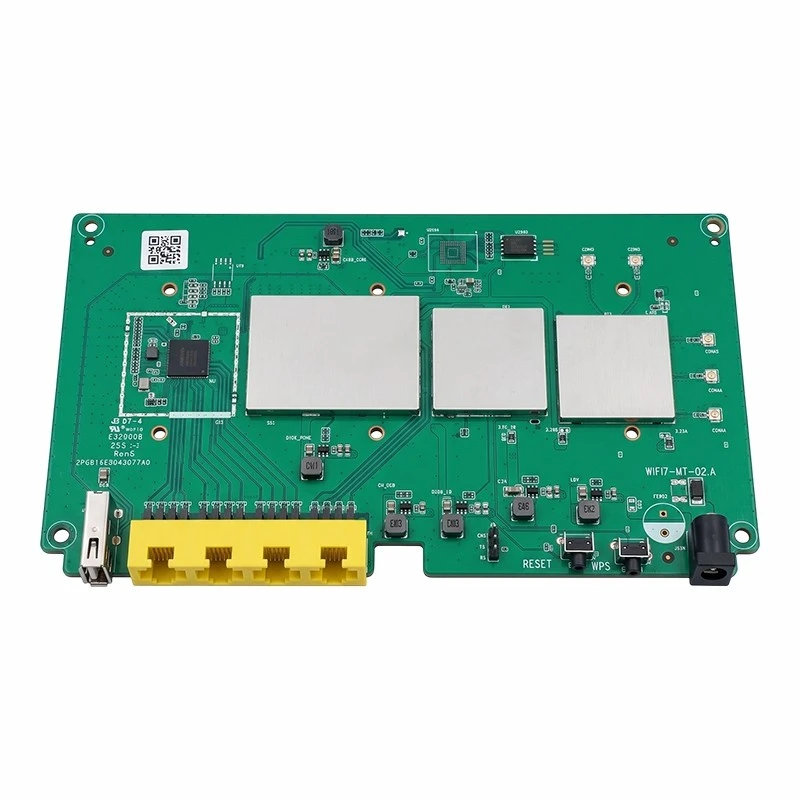
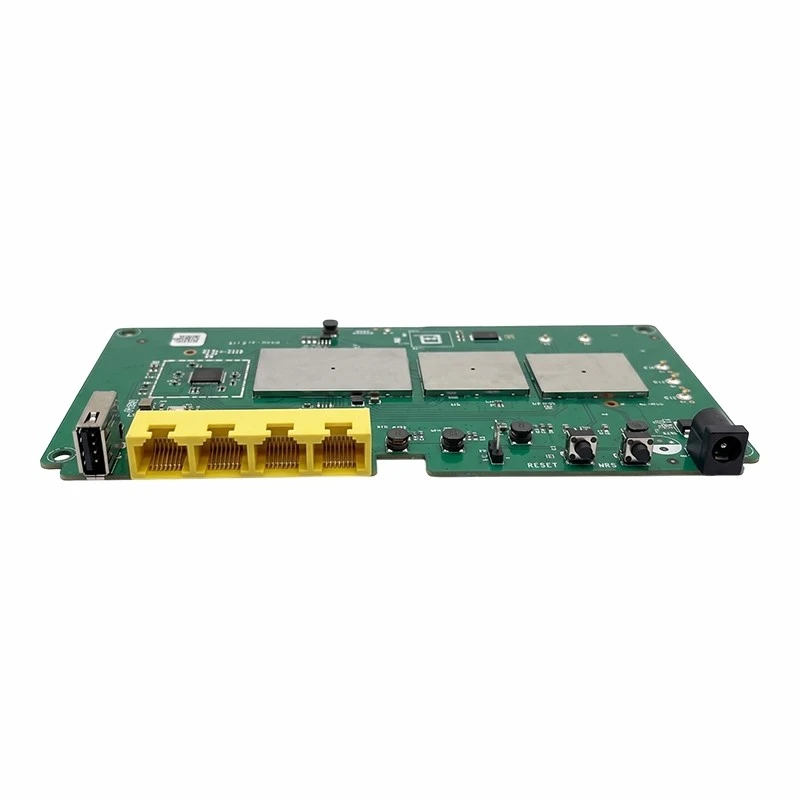
Custom OpenWrt Router
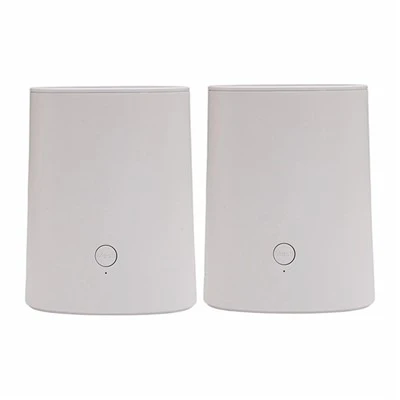
Custom OpenWrt Router Say goodbye to the cookie-cutter, locked-down "black-box firmware" of typical consumer routers. Built upon a clean Linux kernel and a modular architecture, OpenWrt grants users true, unrestricted root privileges.
Description
Shenzhen Youzhi Internet Technology Co., Ltd. is one of the leading manufacturers and suppliers of custom openwrt router in China. If you're going to wholesale bulk high-grade custom openwrt router made in China, welcome to get pricelist and free sample from our factory. All customized products are with high quality and competitive price.
Product Overview
Custom OpenWrt Router Say goodbye to the cookie-cutter, locked-down "black-box firmware" of typical consumer routers. Built upon a clean Linux kernel and a modular architecture, OpenWrt grants users true, unrestricted root privileges. Custom OpenWrt Router Leveraging a vast open-source software repository, the device can deploy encrypted tunnels, industrial protocol gateways, intelligent traffic splitting, and ad-blocking modules on demand. It can also operate completely headless without a GUI to achieve ultra-low power consumption and blazing-fast packet forwarding-transforming your network from passively accepting vendor restrictions into an autonomous, fully controlled private network hub.

Core Selling Points
Modular Package Repository: Tailor-Made Functionality
Break free from hardcoded firmware limitations with one-click package installation and removal via software repositories. Easily deploy WireGuard/IPsec encrypted private networks, MQTT IoT passthrough, Dynamic DNS (DDNS), and multi-WAN aggregation to build a customized network on demand.
Kernel-Level Fine-Tuning: Unleash Maximum Hardware Performance
Deeply customize low-level system settings and scheduling policies. In industrial control or lightweight deployments, disable the Web GUI with a single click to run a silent headless background daemon. This drastically cuts memory overhead and power consumption, delivering sub-millisecond transmission latency.
100% Code Transparency: Zero Backdoors, Ending Planned Obsolescence
Fully open and auditable code eliminates hidden privacy risks at the architectural level. Maintained by a vibrant global open-source community, the system receives continuous OTA updates for emerging protocols and security patches-freeing you from the risk of vendor abandonment when hardware is discontinued.
Enterprise-Grade Security & Native Diagnostic Tooling
Equipped out-of-the-box with granular Access Control Lists (ACLs) and advanced firewall rules. Integrated professional network diagnostic utilities like tcpdump and nmap provide real-time visibility into packet flows and abnormal traffic, keeping your network topology fully transparent.
Target Audience
Network Geeks & Homelab Enthusiasts
Tech explorers passionate about configuring bypass gateways, local smart DNS resolution, ad-blocking traffic control, and deep packet inspection.
Cross-Border & Distributed Branch Teams
High-efficiency teams looking to establish low-cost Site-to-Site VPN tunnels and multi-line bandwidth load balancing.
Industrial IoT & Edge Computing Developers
Automation and system integration teams requiring a lightweight, modular OS with high uptime and multi-protocol conversion (e.g., Modbus/MQTT).
Key Everyday Use Cases
Multi-WAN Load Balancing
Seamlessly connect dual broadband connections (e.g., two distinct ISPs) for automatic failover and load balancing-something standard consumer routers rarely support.
Ad Blocking & Privacy Protection
Deploy plugins like AdGuard Home for whole-network ad filtering, combined with encrypted DNS (such as Cloudflare or NextDNS) to prevent snooping and phishing.
Private Cloud / NAS
Attach an external drive to transform the router into a file-sharing hub, offline download station, and remote media manager.
Intelligent QoS
Set individual bandwidth caps per device (e.g., limiting gaming consoles while prioritizing work PCs) to ensure uninterrupted network performance.
The Fundamental Distinction
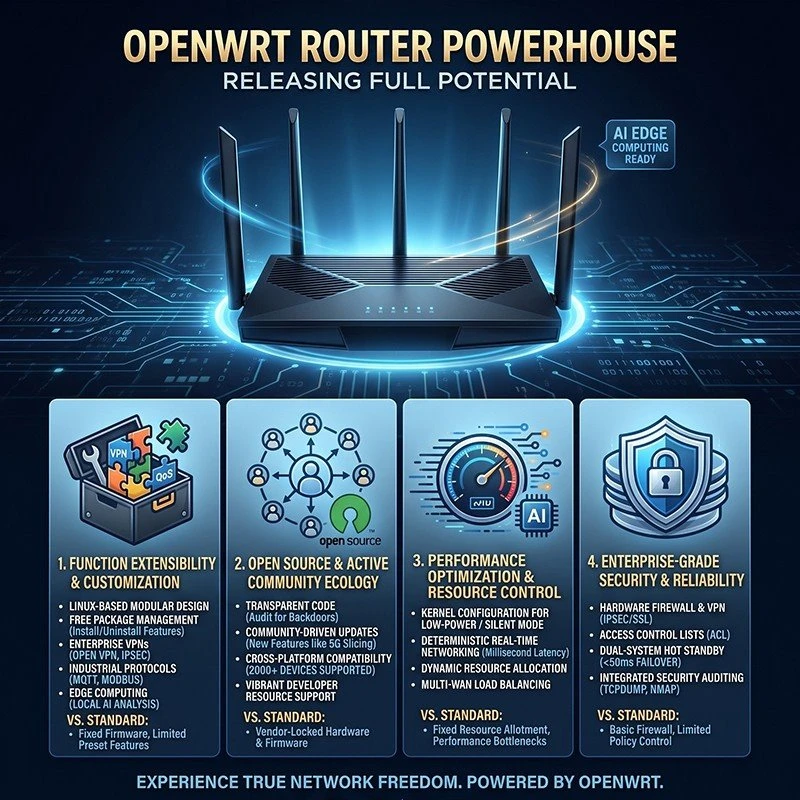
An OpenWrt router is a fully customizable "open-source OS router," whereas a conventional consumer router is a closed-firmware "black box" locked from the factory. While standard routers restrict you to vendor-defined features, OpenWrt lets you install, manage, and remove capabilities just like smartphone apps.
Core Advantages: OpenWrt vs. Conventional Routers
Feature Extensibility & Customization
OpenWrt: Built on the Linux kernel with a modular design, enabling users to install or remove modules via a package manager
Network Protocol Support: Beyond standard NAT and firewalling, it natively supports enterprise VPN protocols (OpenVPN, IPsec) and industrial protocol bridging (MQTT, Modbus).
Edge Computing & Data Processing: Models equipped with AI/NPU accelerators can process local analytics (e.g., industrial condition monitoring), reducing cloud dependency.
Extended Modules: Plugins for ad blocking, multi-SSID management, and multi-WAN balancing cater to advanced home and enterprise needs.
Standard Routers: Firmware features are fixed and limited to basic vendor presets (such as rudimentary QoS or basic guest networks), with zero software extensibility.
Openness & Community Ecosystem
OpenWrt: Backed by an active, global developer ecosystem:
Code Transparency: Auditable and modifiable source code eliminates backdoor concerns and enhances security.
Community-Driven Updates: Continuous delivery of modern features and security patches (e.g., support for 5G network slicing).
Cross-Platform Compatibility: Broad hardware architecture support (ARM, MIPS, x86), compatible with over 2,000 devices ranging from industrial routers to embedded gateways.
Standard Routers: Vendor lock-in prevents upgrading or adopting new protocols, accompanied by little to no developer community support.
Performance Optimization & Resource Management
OpenWrt: Granular control over system resources via kernel tuning and package pruning:
Low-Power Operation: In industrial or embedded environments, non-essential services (such as the Web GUI) can be stripped away, reducing CPU and RAM footprint and prolonging hardware lifespan.
Deterministic Latency: Kernel scheduler tuning delivers sub-millisecond response times required for industrial automation.
Network Throughput Optimization: Tailored routing tables and multi-WAN balancing maximize bandwidth utilization.
Standard Routers: Resource allocation is strictly dictated by factory firmware, preventing dynamic tuning and often leading to hardware underutilization or performance bottlenecks.
Enterprise Security & Advanced Tooling
OpenWrt: Multi-layered security framework:
Encryption & Authentication: Supports IPsec/SSL VPNs, hardware-level firewalling, and unified configuration interface (UCI) based ACLs.
Dual-System Hot Standby: Redundant system failover within 50 ms ensures critical business continuity.
Security Auditing Tools: Pre-integrated diagnostic utilities like tcpdump and nmap allow live tracking of anomalous network behavior.
Standard Routers: Protection is confined to rudimentary firewall settings, lacking granular policies and leaving patch turnaround times entirely at the mercy of vendor support cycles.
Hot Tags: custom openwrt router, China custom openwrt router manufacturers, suppliers, factory
Send Inquiry
You Might Also Like