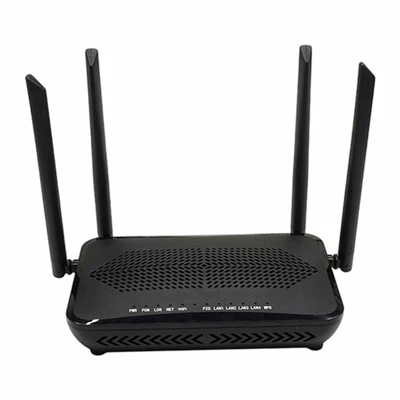
Classification Of Routers
Leave a message
(1) Functionally, routers can be classified into backbone, enterprise, and access categories. Backbone routers handle high data throughput and are critical; they are essential for interconnecting enterprise-level networks. They demand high performance, high speed, and high reliability. Technologies such as hot standby, dual power supplies, and redundant data paths are typically employed to ensure this reliability. Enterprise-level routers connect to numerous end systems; they are simpler in design and handle lower data traffic volumes.
(2) Structurally, routers can be classified as modular or non-modular. Modular routers allow for flexible configuration to meet specific enterprise business needs, whereas non-modular routers offer only fixed, static ports. Generally, high-end routers feature a modular architecture, while low-end routers utilize a non-modular design.
(3) Based on their network location, routers are classified as "boundary routers" or "intermediate node routers." Within a Wide Area Network (WAN), routers can be categorized into these two types based on their packet-forwarding characteristics.
Boundary Category
Although the terminology used for these two types of routers may vary significantly across evolving routing protocols, their fundamental roles remain the same. Clearly, a "boundary router" is situated at the network edge and facilitates connections between routers of different networks, whereas an "intermediate node router" is located within the network core; it typically connects different networks and acts as a bridge for data forwarding.